The Drucker Lectures:
Essential Lessons on
Management, Society, and Economy
Table of contents

Amazon Link: The Drucker Lectures: Essential Lessons on Management, Society and Economy

Previously unpublished talks from the Father of Modern Management
Throughout his professional life, Peter F. Drucker inspired millions of business leaders not only through his famous writings but also through his lectures and keynotes.
These speeches contained some of his most valuable insights, but had never been published in book form—until now.
"The Drucker Lectures" features more than 30 talks from one of management's most important figures.
Drawn from the Drucker Archives at the Drucker Institute at Claremont Graduate University, the lectures showcase Drucker's wisdom, wit, profundity, and prescience on such topics as:
Politics and economics of the environment;
Knowledge workers and the Knowledge Society;
Computer and information literacy;
Managing nonprofit organizations;
Globalization
During his life, Drucker well understood that over the last 150 years the world had become a society of large institutions—and that they would only become larger and more powerful.
He contended that unless these institutions were effectively managed and ethically led, the good health of society as a whole would be in peril.
His prediction is unfolding before our eyes.
"The Drucker Lectures" is a timely, instructive book proving that responsible behavior and good business can, in fact, exist hand in hand.

Praise for "The Drucker Lectures"
"Peter Drucker shined a light in a dark and chaotic world, and his words remain as relevant today as when he first spoke them.
Drucker's lectures and thoughts deserve to be considered by every person of responsibility, now, tomorrow, ten years from now, fifty, and a hundred."
-Jim Collins, author of "Good to Great" and "How the Mighty Fall"
"Rick Wartzman has brought Peter Drucker alive again, and vividly so, in his own words.
These samples of his talks and lectures, because they were spoken not written, will be new to almost all of us.
A great and unexpected treat."
-Charles Handy, author of "Myself and Other More Important Matters"
"Peter Drucker's ideas continue to resonate powerfully today.
His lectures on effectiveness, innovation, the social sector, education and so much more provide fresh insights that extend beyond his other writings and provide lessons for us all.
This book is a gem."
-Wendy Kopp, CEO and founder of Teach for America
"Rick Wartzman has performed a great service in pulling together "The Drucker Lectures".
The collection is as far-ranging as Drucker's thinking and writing.
If you have sampled Drucker before, you will find things you haven't seen.
Peter's ideas live on.
You will be energized by reading them anew."
-Paul O'Neill, former U.S. Secretary of the Treasury
"Peter Drucker inspires awe.
From the 1940s until his death a few years ago, he displayed a combination of insight, prescience, and productivity that few will ever match.
This superbly edited collection captures both the range of Drucker's thinking and the sweep of history that informed it.
"The Drucker Lectures" is a riveting read that reveals the depth and subtlety of one of America's most remarkable minds."
-Daniel H. Pink, author of "A Whole New Mind" and "Drive"
"Rick Wartzman really has brought Peter to life in "The Drucker Lectures".
Reading this book, I practically felt as though I were seated in the audience, listening to my friend and hero, Peter Drucker-truly one of the great geniuses of management.
These lectures are as vital today as they were when Peter delivered them.
They cover significant territory, from the importance of faith and the individual to the rise of the global economy.
It's a classic collection that belongs on every manager's bookshelf."
-Ken Blanchard, coauthor of "The One Minute Manager" and "Leading at a Higher Level"
"Thank you, Rick Wartzman, for the pleasure of learning from the witty, informal Peter Drucker as his ideas unfold and his remarkable mind grapples with challenges of management that are still with us today."
-Rosabeth Moss Kanter, Harvard Business School Professor and author of "Confidence and SuperCorp: How Vanguard Companies Create Innovation, Profits, Growth, and Social Good"
Just reading is not enough
Work has to make a LIFE

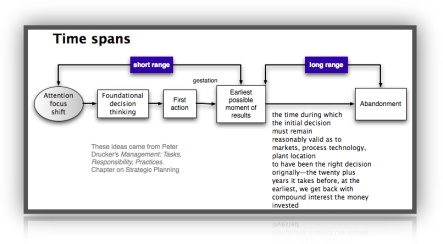
To be of any value
concepts and ideas
have to be made operational.
(calendarize this? ::: #operacy)
And they have to be made
effective (calendarize this? ::: #operacy)
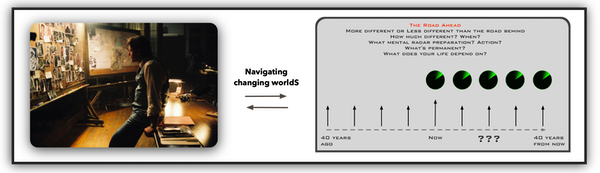
in a world
relentlessly moving toward
unimagined
and unimaginable futureS.
-
CONTENTS
-
Introduction
-
Part I 1940s
-
Part II 1950s
-
Part III 1960s
-
Part IV 1970s
-
Politics and Economics of the Environment (1971)
-
What We Already Know about American Education Tomorrow (1971)
-
Claremont Address (1974)
You asked me today
to talk about management
and what is ahead for it ::: PDF
-
Structural Changes in the World Economy and Society as They Affect American Business (1977)
-
Part V 1980s
-
Part VI 1990s
-
The New Priorities (1991)
-
Do You Know Where You Belong? (1992) ::: PDF
-
The Era of the Social Sector (1994)
-
The Knowledge Worker and the Knowledge Society (1994)
-
Reinventing Government: The Next Phase (1994)
-
Manage Yourself and Then Your Company (1996)
-
On Health Care (1996)
-
The Changing World Economy (1997)
-
Deregulation and the Japanese Economy (1998)
-
Managing Oneself (1999) ::: PDF
-
From Teaching to Learning (1999)
-
Part VII 2000s
-
About Peter F Drucker
-
Books by Peter F Drucker
-
Index
A Year with Peter Drucker
8 Claremont Address 1974
Ladies and gentlemen, I am very pleased to be here today, and I'm very pleased and proud and happy to be a member of the Claremont Graduate School community where I have been now for three very happy years.
You asked me today to talk about management and what is ahead for it.
Perhaps the best way to start might be to say that for the last maybe 25 years, the whole world has been in a management boom.
That's what the Japanese call it.
Until 30-odd years ago, management was a fairly hidden and esoteric concern of a few people here, there, and yonder.
In fact, most managers didn't know that what they were practicing was management.
And between you and me, most didn't.
What was the very small esoteric concern became front-page news.
When I first was ordered to be interested in management I had no such intention until the colonel who commanded me called me in and said, "As of tomorrow you are a management consultant."
I said, "Sir, what is a management consultant?"
And he said, "Young man, don't be impertinent."
Which simply means he didn't know, either.
So I had to learn management overnight.
It was very easy because the entire literature on general management at that time was a small booksheIf of six to eight books and some articles.
Today I think we publish about a thousand books annually that are indexed by the librarians as general management.
That gives you some idea of the boom and maybe also tells you that inflation didn't just begin last year.
But the management boom is over, and incidentally high time, too.
Like all booms, it lasted too long.
Now we face the age of management performance.
For the last 25 years there have been a lot of promises and a lot of good work, but I think the time when we will have to prove that we have learned something in management is just ahead.
But also the time when we will again have to learn new things because the management boom was very largely fueled by knowledge and experience that had been garnered in the long years when management was essentially obscure and was being worked at by a very small number of people in businesses and in a few academic environments.
They provided the capital on which we have been living in management fairly lavishly these last 25 years, and now we will have to begin to get new knowledge, attacking new challenges.
I'm only going to look at some of the things that I think institutions today, let alone those who are coming into management tomorrow, will have to concern themselves with.
We are at the end of what is the longest period of economic continuity in modern western history — almost 30 years since the end of World War II in which essentially the lineaments didn't change much.
This is longer than at any time before.
That era is clearly at an end.
So the manager will have to learn to tackle economic challenges, which he doesn't yet know about.
And incidentally, bluntly, I am very much concerned at the total lack of preparation, and that's a deplorable state of economics, particularly for people who will have to perform.
I am very depressed by the fact that my students don't know anything, and what they know is not relevant.
I think we will have to learn economics, economic structure, and economic dynamics, very much the hard way again.
The manager will have to learn it because the academicians aren't going to help you much.
So he will have to learn.
We will again, I think, have to learn to innovate, for we are at the end of a period of technological continuity.
I know this sounds very strange.
All of us have been led to believe that we have been living in an age of rapid technological change.
And then you look at the facts, and it just ain't so.
Until very recently, there was no industry around for which the basic technological foundations had not been laid before World War I.
The computer, you might say, was the first one of which this isn't true.
Technologically we have been modifying, we have been extending, we have been adding on, but we have not been innovating.
In social innovation, which in many ways is far more important than technological, we haven't been doing much either.
We have been extending and we have been taking fairly well known things to the four corners of the earth, but we have not greatly added.
We are facing a period which is far more likely to be like that heroic age of innovation from about the Civil War period to the First World War.
The period began with the aniline dyes and the first practical dynamo in 1856, and ended with the electron tube in 1911.
A technological innovation came out on average every 14 to 17 months, leading almost immediately to new businesses and new industries.
And incidentally, at the risk of shooting down a favorite balloon, there is no evidence that technology is being diffused any faster today than at any time in the past; in fact, there's a lot of evidence that it is much slower.
Within nine weeks after Edison demonstrated the first electric lightbulb, they sold shares in electric lightbulb companies in England.
And delivered lightbulbs.
They didn't light anything, but within the space of a year they actually had installations in Europe.
The same was true of the telephone.
Things just don't travel today quite that fast.
It's only that they get a great deal more publicity; that is the only real difference.
Now, I think we face a time when major innovations are likely to come, brought about by energy crises, resource problems, but also by new knowledge, which has been accumulating over the last 30 years in physics and chemistry and biology, and information theory, all of which has yet to produce technology.
In the social scene, we probably need even more innovation for the big city, for the environmental problem, what have you.
So I think managers will have to learn to be both managers to husband what we already know and understand, as well as innovators to bring about and make effective and productive what we don't yet know and don't understand.
At the same time, the next few years are years in which the unspoken and passive assumptions most of us still have with respect to managing work and worker will be challenged.
We face demographic shifts of great magnitude, which you can see even more closely outside of this country.
Mexico in the next 10 years will have to find jobs each year for three times as many young people entering the labor force than it ever found in any year of its history.
Most of them will not be highly educated or trained, but better educated than any previous generation.
The same is true throughout Latin America, Southeast Asia, and to a lesser degree in the developed countries.
We are past the population explosion, but we are now facing the effects thereof, particularly the effects of the tremendous drop in infant mortality in the developing countries.
In 1938, the last year for which we have any figures that mean anything, four out of five babies born did not reach age 18 and three out of five did not reach age five.
Now, three or four out of every five reach adulthood.
This tremendous achievement is presenting us with a short-term but tremendous problem for which, incidentally, neither capitalists nor communists have any answer because they've never faced it before.
At the same time, the more important development, perhaps, is that the composition of the labor force is changing.
In this country now about haIf of the young people coming into the labor force have gone to school beyond high school.
They have learned very much.
But even more, they have changed expectations.
First, they expect management to be rational.
They expect management to behave the way they have been told management behaves.
Now you and I, particularly the older ones of us in this group, know that this is sheer delusion.
But they expect that there is a way to make decisions — and it's more than just saying, "Do this because I tell you so."
That there is some thinking ahead, that there is some rhyme or reason behind what management does.
They expect it and, by golly, they're going to get it.
Because don't forget:
They're going to survive us.
They expect that what they have learned will be put to use.
They expect to make a contribution and to earn their keep.
All the things that we have preached to them, they have swallowed.
That may be very stupid of them, but young people do believe what parents and teachers tell them.
And we have told them to expect rationality from management.
We have told them to expect challenge.
We have told them to expect responsibility.
And they expect it.
Above all, we will have to learn to put these tremendous energies to work.
I am frankly not yet seeing any place where this is even practicable.
But I think we owe it to ourselves to do so.
Now, at the same time, we also face a challenge that a good many of us 25 years ago thought we had licked: the challenge of productivity.
The world today is threatened by an inflation that nobody can control and which is probably the worst social poison imaginable.
It dissolves the bond of community and sets class against class.
And in every one of the 30 inflationary periods since the first one, which was in the sixteenth century, the result has been a revolt of the middle class against the establishment, to use modern terms.
They feel a bitter betrayal, real bitter; this one is no exception.
And the only answer to it is productivity.
When I say productivity I am not talking productivity of labor alone, I am talking productivity of all wealth-producing factors.
The productivity of capital may be more important, and it's been going down the last few years.
We also have to make knowledge work productive, including the work of the manager.
I am going to be blunt and say I see very little evidence that knowledge work has become more productive, whether you are speaking of the teacher or the hospital or the government agency or most industrial business managers.
Of course, one problem is that we don't know how to define productivity and knowledge work.
You can't just measure it the way you measure the number of pairs of shoes that come down the line because there are few things as unproductive and as little pleasing to God or man as an engineering department that with great elegance and precision and dispatch and industry designs the wrong product.
So productivity is not easy to define for knowledge work.
But we will have to manage it.
Without it, we will become the victim of expectations.
I've been talking about specifics.
And I really shouldn't.
I really should be talking about something far more important and far more pervasive.
When some of us in this room here were born, the number of people in the workforce of this or any other developed country who worked for organizations was so small that the census barely paid attention.
The great majority of people, of course, were still on the land.
Or they had been on the land only a few years earlier — 1900, 1895, or so.
And there were plenty of people who were employed, but they worked for a master, either as a butcher's boy or as domestic servants or as journeymen in a small craft shop.
And the number of people who worked for an organization was a very small and mostly industrial proletariat out of sight of polite society, by and large.
Today, eight out of ten work for an organization where there is no master, where even the top man is just another hired hand.
And as the events of a few years in the universities made very clear, you can always get rid of a top man if he is a hired hand.
Nothing proved to be more fragile than a university president, as you may remember.
There is no answer anymore.
For the first time in history, this is a society without masters.
There are only fellow employees.
From a lecture delivered at Claremont Graduate School (currently known as Claremont Graduate University).
18 Do You Know Where You Belong? 1992
When I look at people who have done a good job in managing their career — and I don't just mean in terms of jobs and money and title, but in terms of achievement and satisfaction and contribution — these are people who build a network.
This is a modern term.
We didn't speak of it 10 years ago.
Back then, we said, "These are people who keep in touch."
Today, they build a network.
In a way, they have learned how to be considerate.
And, believe me, I don't think people are born considerate.
There are some people who are born more polite than others.
But considerate?
No.
Considerate is doing a few elementary things.
The first is to have a tickler file in which you have enough information about the people you work with to be considerate.
To call up and say, "Mary this is your wedding anniversary — 20 years.
Isn't it wonderful?
Congratulations."
And you know, those of us who have been married a long time have learned that the husband had better not forget the wedding anniversary.
But no husband remembers it after 35 years, so we have it in our calendar.
We have a tickler file.
And one learns that you keep a tickler file with the names of the children of the people you work with, and their birthdays, and their wedding anniversaries.
And that's being considerate.
That's showing respect.
You also don't lose touch with the people with whom you've worked.
And it's not just sending a Christmas card.
And, by the way, don't send that canned Christmas card — the Xeroxed one that begins, "It's been a very eventful year for the Jonas family.
Our grandchild got his first tooth … "
Don't send that one.
But when you're in Tacoma, pick up the telephone and call that fellow who has been transferred there and say, "Joe, I'm in town.
I don't know whether I have enough time to get together with you.
But I just wanted to say hello and find out how you're doing."
Keep the network.
In the first place, you may need it.
During the last three years, an enormous number of people have been forced to find another job.
Maybe you've been with the same big company for 26 years.
You've never had to write your résumé.
One more promotion and suddenly, at age 49, you're out.
It's traumatic and painful.
And we've had study after study on what makes the difference between those who were able to find a new job relatively easy and those who couldn't.
What kind of experience and expertise you have makes a lot of difference.
But when it comes to people of the same age, with the same expertise and the same background, the ones who do well are the ones who know where they belong.
They know their strengths, know their performance, and can position themselves.
The other difference for those who do well is that they have a network.
They've never lost touch.
These are not close friends, but they are people who know you and whom you know.
And again and again, when one of them gets that letter or telephone call, he calls right back and says, "Gregory, I think have a job that might interest you.
Do you mind if I talk to my friend Joe down the street about it?"
And two weeks later you have an interview with Joe.
Again and again, this is a balance between how you present yourself — not bragging about yourself but knowing yourself.
And knowing how to maneuver yourself, which is what a network really is.
It isn't being popular.
It is being considerate, and not using people just as tools but as people.
Another skill:
Make sure that before you are in your forties you have a real outside activity.
Not just a hobby but an activity.
First, it creates an entirely different network.
I teach a fairly large executive management class — about 60 people.
A number of them are from the aerospace industry, which has been very turbulent for three years now.
And at least haIf of them have had to change jobs.
And so I said, "How did you get that new job?"
You'd be surprised how many of them say, "Marianne and I belong to that church and we are volunteers together.
And when that big aircraft company laid me off, it was through the other volunteers in that church that I immediately found leads."
It's another network.
And it is one very powerful one, by the way.
But that is the lesser importance.
Its major importance is what it does to keep you alive and to enrich you.
Believe me, very few jobs still have challenges after 20 years.
The worst are those brilliant young college professors who begin to teach French history at age 28 and love it and are excited and bubble over, and every day is sheer joy.
And 50 years later, they're bored even by their own jokes.
And so is the class.
And that's when people say they're burned out.
No, they're not.
They're bored.
They need another challenge.
There are two kinds of challenges.
The more important — and the easier — one is what I have come to call the parallel career.
In this country, haIf of our adults work as a volunteer for at least three hours in a nonprofit agency of some sort.
And for many, this is no longer addressing envelopes.
They run their church.
They run the training program for the Girl Scout Council.
They design the training program.
This is an unpaid management job, an executive job.
In some cases, it offers more responsibility than what they have at the bank or the insurance company or in the trucking company.
And it keeps them alive.
It's a new challenge.
It's a new environment.
It's different people.
And if forces you to remain adaptively innovative.
When I look at those college professors at age 43, I realize that a good many of them should now do something else.
They are not going to produce those great scholarly books they talked about 15 years ago.
There were those two little magazine articles, that's all.
They are no longer the greatest classroom teachers, if they ever were.
They have lost all flexibility, all elasticity.
They are stuck.
Not in the routine.
It shouldn't be a routine.
They are stuck in their own kind of premature aging.
And then I look at the ones who are different.
And almost without expectation, here is that colleague at age 46 who is not a very great scholar but he is still full of enthusiasm in his classroom.
He runs one of the Boy Scout troops on the side.
And every weekend is a new challenge.
Nine-year-old boys are a new challenge every weekend.
He comes back from that weekend totally exhausted and just full of ideas.
Keep that in mind.
You need that outside activity precisely because the job tends to become all embracing, precisely because you take work home at night.
But it's also because the great majority of us reach the ceiling in terms of advancement and promotion in our early forties.
You need something that is not routine, and you need to build it into your life early — something that is meaningful to you, that cause you believe in.
Something where you can contribute, where you can take leadership.
Something where you can say, "I'm making a contribution."
At the same time, you should also learn to look at yourself and assess,
"When do I belong elsewhere?
When do I not need a parallel career
but a second career?"
Go back not very long — make it a hundred years.
At age 43, that farmer in North Dakota was a very old man, and his wife was a very old woman, if she was still alive.
And he was no longer capable of working.
If he hadn't been injured — and most of them were — the work was terribly hard.
And there were those lonely winters with the howling wind, day in and day out.
It took a heavy toll.
Now, that farmer in the North Dakota prairie didn't expect fulfillment from his job.
All he hoped was that he would be able to feed his children over the winter, and it was touch and go.
It was a living.
It wasn't a life.
And the steelworker didn't expect fulfillment out of the job.
He expected paychecks that would enable him to feed his children.
But knowledge workers expect fulfillment.
We also don't get injured anymore.
Sitting behind a desk, the worst work-related injury we can expect is hemorrhoids.
And that doesn't disable you.
And so now we have very long working lives.
And we will have to learn to take responsibility not just for a parallel career but also for a second career.
How do I repot myself?
At what age?
And when the job becomes simply a place to hang your hat, when it's "Thank God It's Friday," when you begin to play games with yourself so that it makes the job more complicated, then you are bored.
And boredom is a deadly disease.
You need to be challenged.
The great danger is that you live physically long and die mentally too soon, and the waste I see of ability and talent is dreadful.
So don't say, "I'm stuck in the groove."
Say, "Where do I belong?
What do I have to contribute?"
From part of a lecture series for George Washington University.
27 From Teaching to Learning 1999
As you know, there is an enormous amount of talk about schools.
I started counting, and I ended up with about 40 different approaches all over this country—and not just all over this country, all over the developed world—aimed at restoring the school of yesterday.
And I'm all for it.
Let me say the school of yesterday had one enormous advantage.
Yes, the children did learn basic skills.
But perhaps equally important, they acquired self-confidence.
In the school of today, or a very large number of the schools of today, children lose self-confidence, and that's the greatest barrier to learning.
At the same time, we know that the school of tomorrow will not just be a restored version of yesterday's school.
We know that it will have to be a very different school.
And we know why, and we know how.
The basic reason is not technology.
And it is not educational theory.
The basic reason is the change in demographics.
When I was born, there was no country in which more than three out of four people in the work force did not work with their hands.
They worked with their hands as farmers, as domestic servants, as store clerks, in small shops, in factories.
And today in this country, only two out of every ten people still work with their hands, and the percentage is going down.
And of the eight out of ten—the 80 percent who are no longer manual workers—half of them are being paid for putting knowledge to work.
And it isn't only that they need a very different preparation.
It is, above all, that they need to learn something that yesterday's school paid no attention to:
They need to learn how to learn.
Knowledge makes itself obsolete very fast.
This coming Saturday I will teach—I still teach all day—our advanced management program, and about half the people in it are engineers.
I asked them when we began this course a few weeks ago, "How often do you have to go back to school?"
And they said, "Every other year, at least, to keep up with the changes.
And every three or four years, we go back to relearn the basics, or we're obsolete."
And these are not high-tech people mostly.
They are mostly people in traditional industries—a lot of automotive, a lot of aviation, a lot of machine tools.
And yet this knowledge changes so fast.
And the same is true of the physician or any other knowledge worker.
I work closely with our big local hospital on the training of nurses, and they have to go back to school at least once every year for several weeks, and every three or four years for three months, or they're hopelessly behind.
This is something fundamentally new in human history.
And it means that the most important thing to learn in school is how to learn—the habit of continuous learning.
Add to this that knowledge is effective only if specialized.
I may need a knee replacement in a few weeks—an old skiing injury.
And I'm going to somebody who does nothing else but knee replacements.
And that's true in all areas.
At the same time, as you go up even a little bit in organizations, you increasingly will have to relate your specialization to the universe of specializations.
The orthopedic surgeon who will do my knee told me that he's now taking a course in physical therapy.
He is not going to become a physical therapist, but it's changed so much in the last few years, and he has to know enough that he can tell his patients what they need to do.
And, again, this requires the ability to continue to learn.
Another thing:
Working life has extended so much in the last 50 years that it exceeds the life expectancy of even the most successful businesses.
Very few businesses are successful for more than 25 or 30 years.
And yet most educated people who go to work in their early twenties will keep on working until they are 70.
And so they [had] better be prepared for a second career, whether it's in another organization where they're doing what they have been doing or in a new line of work.
They must be prepared to learn again.
They must be prepared to position themselves.
They must be prepared to want to learn—to see it not as something they need to do, but as something they enjoy doing.
They will have to learn how to learn.
They will have to have acquired the habit of learning.
We also know the implications of these changes.
We know that this means a different focus very early in education.
When you look at the school we have, it started in Florence around 1756, 250 years ago, and it was a school that quite rightly for its time focused not only on base skills but also on bringing everybody up to a minimum.
And therefore it focused on the weaknesses of the student.
And so it is today.
Not long ago, I visited one of my children and her daughter in fourth grade.
And I went along to the parent-teacher meeting.
And the teacher came up to us and said, "Ah, you're Mary Ellen's mother.
She needs more work on division."
She didn't say that Mary Ellen, this granddaughter of mine, is an excellent writer, loves to write stories.
She didn't say, "She ought to do more stories."
She rightly, understandably, focused on what Mary Ellen needs to do to come up to the minimum.
But that is counterproductive if we're focused on getting people to learn.
We know that nothing so motivates people—nothing—as much as achievement.
And, therefore, we will have to focus learning on what children and adults excel in.
I get incredible, fabulous work from my advanced students because they are 45 or 48 years old and they are corners, or their organizations wouldn't send them to us for a year or two or three.
And when I say, "What are you good at?" they usually don't know that.
Then I say, "I want you to write your first paper on what you are good at."
And you have no idea what an explosion I get because they reach for excellence, and now they're reaching for excellence in everything, even the things where they are very poor.
They are motivated by achievement.
And this is nothing new.
Every one of the great educational leaders since [eighteenth-century Swiss pedagogue Johann Heinrich] Pestalozzi knew it.
But we can't do it in the normal schoolroom of yesterday with 30 children, where everybody has to come up to a minimum level and the minimum skills.
Instead, we have to focus on "your Mary Ellen needs more work on division.
She is not very good at it."
The teacher can't say, "She ought to do more writing."
She paid no attention to Mary Ellen's writing because it didn't need any attention.
Mary Ellen is good in writing.
What does she need any attention for?
But we know that if you want to create the habit of learning, you have to give children a sense of achievement, and that means building on their strengths.
The weaknesses are universal.
The strengths are individual—and that you can't address in the traditional classroom.
We also know, by way of implementation, that in order to acquire the habit of learning you have to manage yourself.
And, incidentally, this is probably one area where the computer is a real help, because when you look at those 5-year-olds with the computer, they are way ahead in computer literacy—way ahead of me.
Well, 85 years ahead of me.
When you look at them, they focus on what they're good at, whether they play computer games or do simple learning work.
They manage themselves.
They go back to what they're not good at.
But they focus on what they're good at, and it motivates them.
The computer has given them competences, but they can't utilize them in the traditional classroom.
And so we already know the specs of the school of the future.
The focus is going to be on learning.
And the teacher's job will increasingly be to encourage learning, to help learning, to assist with learning, to mentor learning.
That will require a good deal of teaching, but the starting point will be learning and not teaching.
And we know quite a bit about it.
First, we know that learning is very individual.
There are some children who never crawl—who go straight to walking from sitting up.
And others keep on crawling until they are 3.
But by 3, they can all walk.
Learning is individual, and learning builds on what we are good at.
And this we know is going to be one of the specs:
How do we enable children to focus on what they're good at, on their strengths?
We also know that the best way to learn, especially for young people, is to teach.
I learned that when I was a sophomore in high school, and my closest friend was one year younger.
He was a very bright boy, but he had difficulty learning the traditional key subjects of my Austrian school:
Latin and Greek and math.
He was a very gifted musician, and made a very respectable career in music, ending up as conductor of a major orchestra.
But in Latin and Greek and math, the key subjects, he was slow.
And so I began, without any conscious effort, to tutor him.
I myself had been a very indifferent student—not because things were difficult, but because I was lazy.
Yet six weeks after I began to tutor Ernest in Latin (which I wasn't particularly fond of) and Greek (which I loved) and math (which I was good at), I suddenly was at the head of my class.
Suddenly I enjoyed all of these subjects.
Joy is the right word.
And I learned them because I had to explain them.
And suddenly it hit me:
The best way to learn is to teach.
Indeed, one of the reasons why the one-room schoolhouse of a hundred years ago was such a good learning environment is that the teacher with 70 kids from ages 6 to 16 had to use the older children to tutor and mentor the younger ones.
And the older children learned.
And we know that this is part of the specs for the school of tomorrow:
How do we put the more advanced youngsters to work teaching so that they not only learn but also discover learning and the joy of learning?
Finally, we know that we can do these things.
And this is where technology comes in.
Technology makes it possible for the individual student to work individually, and work at his or her own speed and rhythm and attention span.
Rhythm is especially important because if you violate it, you create fatigue.
And so modern technology enables especially young children to work how they learn best, so that they can achieve.
Technology can also greatly extend a teacher's span, the time a teacher has to spend with individuals.
That's because the custodial job, which takes so much time, even in high school, can be taken over by technology.
With technology, a student manages himself or herself very largely.
Yes, you have to supervise them, but to a large extent the oldest children do that, if you use them as teachers, just as I supervised many years ago that Latin school friend of mine in doing his algebra.
We know that the new school is not going to be cheap—and it shouldn't be.
A good school never has been.
It is, after all, the real capital investment of a modern economy.
But it'll probably be cheaper than the traditional school.
The technology is no longer very expensive, and it's getting cheaper by the day.
But the main, the central, the profound shift is that the school of the future is one in which the focus is on learning.
That's always been the end product of the school.
But the focus of the traditional school is teaching.
We have no "learning colleges"; we have teachers' colleges.
We don't really talk of good learners; we talk of good teachers.
We need teachers' colleges and we need good teachers, but we will have to develop something that historically we've paid no attention to:
good learners.
Historically, for the great mass of students, we aimed at minimum skills, very low skills, skills so that they were not disadvantaged.
In a knowledge society, education has to be the way for everyone to find what he or she can excel in—to set a standard and not just meet it.
And that means a different school, and not in its class size.
The new technology makes larger classes more productive.
And there is almost no evidence for the idea that small classes give better results unless the class is very, very small.
But once you have 15, it makes no difference anymore.
And in order to have enough excitement in the class you probably need larger classes.
Small classes are dull; there's not enough variety, diversity, not enough mutual stimulation.
I think the present emphasis on small classes is a misunderstanding.
The school of the future will be different from the school of yesterday not just because we will expect most of the students to have one area of achievement, and not just a general universal mediocrity, but because its emphasis will have shifted from teaching to learning.
From a speech delivered at a "School of the Future" conference, sponsored by the accounting firm Arthur Andersen.
28 On Globalization 2001
Let me start out by saying that maybe six weeks ago I had a visit from an old student.
Forty years ago, he was a young Taiwanese.
In the meantime, he has built a very successful business in Taiwan, and for the last seven years or so has been in Shanghai, where he is now head of a very large joint-venture firm.
And I asked him, "What has happened?
What's the most important thing that has happened in China the last three to five years?"
And he thought for about five seconds and then said, "That we now consider owning an automobile a necessity and not a luxury."
That is what globalization means.
It is not an economic event; it's a psychological phenomenon.
It means that all of the developed West's values — its mindset and expectations and aspiration — are seen as the norm.
Note that my friend did not say everybody in Shanghai now owns a car.
Far from it.
He did not say that everybody in Shanghai expects to own a car.
They're at the stage where they are shifting from bicycles to motorbikes, which is deadlier.
He said that owning a car is considered a necessity, and that is what globalization actually means.
It is a fundamental change in expectations and values.
And what are some of the implications?
Let me say there are still parts of the world where globalization has not happened.
Africa, certainly not yet.
But a few years back we were in Paraguay, which is not exactly in the center of things, especially if you get into the interior.
And yet it was very clear that in this desperately poor country with little education, the values are clearly those of, well, the developed world.
And maybe in the interior of China, way back in rural China, globalization has not yet really penetrated — though I think it might be getting there.
But other than that, this is now a universal phenomenon.
The first implication is that competition means something different than it used to.
And this is why I am convinced that protectionism is inevitable, not in a traditional form but in new, nontraditional forms.
And yet it will not protect.
Let me give you a simple example.
A few months ago, as all of you perhaps remember, the US steel industry complained about the dumping of hot rolled steel, which is used for automobile bodies.
And so President Bush ordered steel imports stopped.
But the automobile companies in this country, including the Japanese, are not paying the price the steel companies ask.
They negotiate to pay the price that they would have had to pay if Bush had not stopped the dumping.
Toyota, for one, has said very loud and clear to the steel companies:
"If you don't give us the steel at the world market price (which is 40 percent below the American price), we will simply shift more of our body manufacturing to Japan and to Mexico.
We'll cut body manufacturing in this country by 80 percent within six months."
And they are now negotiating for the next model year.
Ford is doing the same.
And that is going to be the norm.
Globalization does not mean that there is worldwide trade in goods or services.
It means that there is worldwide information.
And that is the determining factor.
There is also talk that all of our jobs are being exported overseas.
This is simply nonsense.
It's labor union propaganda — primarily garment workers' propaganda.
Actually, foreign investors in this country have created four and a haIf times as many manufacturing jobs as we have exported.
Yes, the three domestic automobile companies are shrinking.
But practically none of the shrinkage of manufacturing jobs has anything to do with product moving overseas.
It has to do with the fact that we are in the midst of a major industrial revolution in manufacturing technology, as profound as the shift to mass production in the early 1920s.
When I first talked about it in 1969, I called it "flexible mass production."
The name for it is now "lean manufacturing."
In mass production, the rule was very simple.
The mass production people said to the engineers, "You give us your designs, and we'll figure out how to make them."
Now, you design so that it can be made.
And let me say that [pioneering quality consultant W. Edwards] Deming — and he was a friend of mine — is totally obsolete.
Quality control was on the plant floor.
The new quality control is in the design stage.
That is a radical change from the mass production approach, in which engineers and manufacturing people basically didn't talk to each other, had infinite contempt for each other.
The engineers looked upon the mass production people as "just the toolmakers," and the mass production people looked at the engineers as "those arrogant snobs."
Today, you begin with certain manufacturing specs and the quality specs in the design.
And that is what underlies the greatest shrinkage of jobs.
Perhaps what is most amazing is that this tremendous change had caused no social disruption in this country.
You explain it to me; I don't understand it.
We have had no social problem of transition.
So, what are the greatest challenges ahead?
I'm an old consultant, and so my answer is colored by my experience.
The most difficult problem I have found with my clients, whether they are profit or nonprofit, is to change their mindset.
It's not technology; it's not economic conditions.
It is to change their mindset.
The most difficult period of my lifetime was immediately after World War II.
Practically all the people who ran institutions were absolutely certain that we would have a major recession after the war.
And it was incredibly difficult to change that mindset when, during the years of the Depression, the goal was to survive.
And I'm not just talking of business.
I joined a major business school [at New York University] in 1950, and our big problem was that our dean, who had kept that school together during the Depression — and it wasn't easy — could not be convinced that our enrollment was going up.
He just could not believe it, and it was absolutely clear that we needed a new building, and he refused, saying, "Well, that isn't going to last; it can't."
And he was fairly typical.
After all, every major war since the mid-seventeenth century had been followed by a major recession.
And so there was no precedent for what happened after World War II.
And nobody can explain it to this day.
The few who were willing to accept the facts — like the man who built Sears Roebuck, Gen. [Robert E.] Wood — succeeded without even having to try very hard.
But most of the senior management people, and not just in business but also in education, failed miserably and were out within 10 years because they could not accept the facts.
They could not change their mindset.
During the 1920s, there was increasing protectionism, increasing isolationism, and an increasing push towards self-sufficiency.
And then came the Depression.
And around 1950, I was working quite a bit with the New York banks, and they could not accept the fact that there was suddenly international banking.
And most of these banks disappeared, very largely because they could not accept the fact that there was economic expansion and international business.
So this is always a great challenge.
I am also bothered by the fact that so many of my friends in American business — and European business is worse — have become captives of their computer.
The computer is fascinating, but let me say it is fascinating for mental age 5.
That's probably the age at which people are best on these computers.
All it gives most of you are inside data, accounting data in infinite detail.
And we cannot put outside data on the computer because they are not in computer-useable form.
To put things on the computer, they have to be quantifiable.
But very little information about the outside is in that form, and so the computer people dismiss it as being anecdotal.
How do you quantify what this Chinese friend of mine told me when he said that the people in Shanghai and Beijing now consider owning an automobile a necessity?
You can't quantify it, but it tells you more about China than all the Chinese statistics.
It tells you that you have a totally different country.
It's a poor country now, but it's no longer an underdeveloped country.
It's a fundamental difference.
You can't quantify it, but spend 10 minutes in either city and you'll know the difference.
And if you only look at your computer data, you'll never find out.
From a lecture delivered at Claremont Graduate University.
30 The Future of the Corporation I 2003
Just the other day I had a telephone call from an old friend in Europe, who was my student in New York about 45 years ago.
He called up to tell me that he had just been named CEO of one of the major European multinationals.
And then he said, "Peter I have a question:
Does the corporation have a future?"
And I said, "Yes, but it will be different."
We could talk, for instance, about moving from control by ownership to control by strategy.
Or we could talk about moving from the monolithic corporation, which owns everything that it does, to a confederation based on alliances and relationships.
Everybody in this room, including myself, takes the corporation for granted.
We don't realize what a recent development it is.
How unprecedented it is.
If you want to understand how unprecedented the corporation is, have a look at all the good business novels of the period just before it—[Charles] Dickens in the English language and [Honoré de] Balzac in the French.
It is no accident that, by contrast, we do not yet have a good corporation novel, not a single one.
It is too new.
What brought the corporation into being?
What advantages does it have?
These questions weren't even asked until just around World War II.
That's when a very brilliant Englishman [Ronald Coase], who went to the University of Chicago and won the Nobel Prize [in Economics], noted that there are two kinds of costs:
"transformation costs," which are the costs of inputs used for production, and "transaction costs," which include information costs and bargaining costs and the costs of keeping trade secrets and so on.
And he said transaction costs have reached the point where they are equal to transformation costs.
And this brilliant Englishmen pointed out [in his 1937 article "The Nature of the Firm"] that, by putting all transactional costs under one hat, you have enormous savings.
And that is probably the main reason where around 1860, you suddenly had a need for business skills.
If you think business skills are very old, you are totally mistaken.
Let me just give you a personal example.
This is from the early 1920s, when I was in middle school.
And my father rightly decided that I would have to earn my living and that I was totally unqualified for it.
And so he sent me, after Latin school during the day, to an evening course at a commercial high school that taught business skills.
A few years later, I became an apprentice, a trainee, in the largest European export firm in Hamburg.
And we were the first trainees who had finished secondary school.
Everybody else had always gone to work at age 11.
And the office manager said to us:
"Gentlemen, I hope you don't mind if I tell you that you are much too highly educated ever to be a success in business."
And he was right.
And then he said, "If you want to make a living in business, you need three skills:
shorthand, typing, and double-entry bookkeeping."
I don't think even an old-fashioned business manager in an old export firm would say that today.
But this was the beginning of that unprecedented social organization—the corporation—and let me say that no institution in human history has risen faster.
But now it is changing.
In what way?
For one thing, the old assumption was that you would take a job and hold onto it.
Around 1955, I ran a study of the management people at General Electric.
It was a large group.
And while a very substantial proportion had had their first job elsewhere, something like 89 percent came into GE as their second job and then stayed there for the rest of their working lives.
That may still be true at some traditional companies, the last of which is IBM.
But it's not true with Microsoft.
A friend of mine, who is very high up in human resources at Microsoft, told me that for 90 percent of the people there, it's their fourth job.
He also said that the company figures on turnover of 60 percent.
If I had told that to anybody at GE, they would have fainted.
Another big change is that companies have given up the basic assumption, the automatic assumption, that whatever we do, we do it in-house.
The basic assumption today is:
What we don't do day in and day out, we outsource.
To do things in-house, you have to have core competence in them because you do them all the time and, therefore, can attain excellence in them.
The rule, increasingly, is:
"We do only what makes us distinct, what makes us unique."
As for outsourcing, the cost savings are largely accounting fiction.
The real reason for outsourcing to organizations that do nothing but manage data processing equipment or do a particular kind of research is that this is the best way to make knowledge productive.
The corporation of tomorrow will be a place that finds the outside organization that does a specialist's job the best because it does nothing else.
That friend of mine who called from Europe spent years building competences within his company.
But he has spent the last 20 years outsourcing them.
And he said the newspaper reporters covering the company don't understand it.
Total sales have tripled, while employment is a quarter of what it was.
They think the company has become more productive.
No.
It has outsourced.
These people doing the work are not employees of the company anymore.
About two-thirds of the people who work for them are not their employees.
The fastest-growing industry segment in the United States is made up of professional employee managers—companies that manage the employees of other companies.
The largest is called Exult, and it's down in Irvine [California].
It manages for British Petroleum and Unisys and what have you.
These people are employees of Exult.
They work full-time for many years for British Petroleum.
Whose employees are they?
British Petroleum is not equipped to manage them.
Exult just provides labor, basically.
One of the very big challenges is how do we learn to manage—manage may even be the wrong word—to look after the people who work for us full-time, year after year after year, and who are not legally our employees.
How do we do that?
Nobody yet knows how to do that.
Don't ask me; I don't know.
Sixty percent of the people who work for Fuji are not their employees.
And they have no personnel policy for them.
And it causes no end of trouble.
So what you see very rapidly is that the corporation of tomorrow has contracts here and minority participations there and know-how agreements.
It is a network.
It is a confederation.
And so you have to learn to work with people whose values are different and whose goals are different, and whom you can't control.
The secret of an alliance is that you start by asking your partner:
"What are you trying to achieve?
What is important to you?"
You don't say, "This is what we want from you."
Rather, you ask, "What do you want from us?"
And this is going to be central to the corporation.
Another change:
Since at least 1950, we've worked on the productivity of capital with very great success.
We now will have to work on the productivity of the new workforce.
One area to consider is the ratio of women to men.
Look, 30 years ago in a meeting like this, there would have been practically no women.
Now, it is about 50-50 in here.
Will we men accept the fact that the smart thing is to let the women work and we enjoy it?
I'm serious.
They are incredibly eager to work.
In fact, throughout history, men and women have always worked.
The idle housewife who sat at home and spun a fine seam is a nineteenth-century fiction.
You could not run a farm unless you had both a farmer and his wife.
And vice versa.
The woman alone couldn't run the farm, either.
The best farmers we have in the world happen to be the Moravian in Pennsylvania, and they have a strict rule that if a husband or a wife dies, the survivor has to marry within six months or you lost the farm.
By the way, the Salvation Army has pretty much the same rule.
There is no such thing as a Salvation Army captain; there is a Salvation Army captain—a male—and there's his wife, who is also a Salvation Army captain.
So this is nothing new.
At the same time, men and women have often done different work historically.
Go back to our ancestors, when the men hunted and the women picked edible weeds and took care of the children.
The first civilization for which we have good commercial records is the Sumerians.
And the traders—the people who transported goods—were all men.
And the scribes were all men.
But the ones who set the prices—the controllers, you might say—were all women.
There is no record of a male controller who said, "Six oxen equal 94 pieces of pottery" or what have you.
That was all women.
In this country, men milk cows.
In Europe, women milk cows.
We don't know why.
On the other hand, up until about 1700, there were no women weavers.
Spinning was for women; weaving was for men.
In Japan, until World War II, there were only male potters.
So, historically, men and women did different work.
And that is still true of nonknowledge work.
But knowledge work is different.
The first modern form of knowledge work to come on the scene was nursing.
It was 1854, with the Crimean War.
And it was all women.
Now, though, half of the students in our nursing schools are men.
Women physicians came in first in this country, then in England, and then in Austria between 1860 and 1890.
Madame Curie's sister [Bronislawa Sklodowska] was the first woman doctor graduated in Paris.
So in knowledge work, men and women do the same work.
This is new and unprecedented.
It is a recent invention.
And, by the way, it has its problems.
It is still very difficult in Europe.
In Japan, it is impossible.
We are about the only country where the problems are not major.
In this country, we have adapted to this very easily.
From a lecture given at Claremont Graduate University.
31 The Future of the Corporation II 2003
Our topic today is:
What are results?
And that sounds like a very simple topic, but I've been working on it now for quite some time, and it's becoming worse and worse and more complicated.
And so I hope you will forgive me when I don't make sense because there are some areas where I know I don't make sense but I haven't worked my way through.
We have moved into a society of organizations.
And what all of them have in common—maybe more or less for the first time—is that they have results only on the outside.
If one of you has to go to the hospital, you couldn't care less whether the nurses are satisfied.
The result you care about is a cured patient, not a satisfied nurse.
And a cured patient is one who leaves under his own steam and doesn't come back.
That's a result.
And the same is true of all the organizations in our society of organizations.
And yet when you look at what we have been writing about and thinking about in management, including all that I have done, we have looked really only at the inside.
It makes no difference whether you take an early work like my book The Practice of Management [published in 1954] or [Harvard Business School professor] Michael Porter's books on strategy.
They look from the inside out, and they really talk about organizing the inside of an organization.
And so if you want to have an understanding of what management is and what management does, you have to start with results on the outside.
In many cases, it's not easy to define results.
I've been working with some excellent Midwestern colleges.
But what are their results?
Is it how many people get into Harvard Law School?
That's probably a minus.
Or tell me what the bottom line is for a hospital or for the Girl Scouts or for a church.
You'd be surprised how difficult it is.
We know that the bottom line for a business is net income.
But what about market standing?
That is not so easy to define, and it is changing very rapidly.
From the point of view of the shareholder, the only thing of interest is financial results, whether it is dividends or the stock price.
From the point of view of the enterprise, the question is:
How do we get capital the most cheaply and how do we use it the most effectively?
But you'd be surprised, whenever you raise this question how management differs.
Let me give you a recent example.
There are two department store chains that are very similar.
Both came to me independently and at different times about what they should expect from their salespeople.
One of those chains defined the results of the salespeople by the size of the sales ticket—whether the item sold on one ticket was for $6.15 or for $615.
The other sees the results of its salespeople as attracting and holding customers.
They judge their salespeople on whether Mrs. Smith comes in and asks for Betty.
Does Betty build a customer base?
And let me say that when you look at it from the point of view of ultimate income to the store, the two are indistinguishable.
You can't say one is a better way.
But they are totally different.
They lead to hiring different salespeople, to training different salespeople, and to paying them differently.
And the saleswoman who does well in chain A is unlikely to do well in chain B, and vice versa.
So results are not that obvious.
One of the great weaknesses we have in the business schools today is that we believe results are obvious.
Another is that, so far, we have looked at management from the inside out.
We have not yet begun to look from the outside in, and I have a hunch that this is going to be the next 30 to 40 years of our work.
All of our early organizations had one major goal, which was to prevent change or at least to delay it.
But the business organization exists to create change and to exploit change.
All early organizations also aimed at monopoly.
But the modern organization—and I'm not talking only of business—exists in a competitive world.
And so you have to ask:
What does this mean in terms of results?
It used to be that if you had a paper company and you had a paper laboratory, all the work of the lab went toward the production of paper, and everything the paper industry needed came out of that lab.
That was the theory on which the great labs of the nineteenth century were founded.
They were focused on one industry, and it was the common assumption that to a given industry pertains a certain technology and to a given technology pertains a certain industry.
Most of us in this room still believe this.
But if you look at where the competition comes from now, that's not the way it is.
Today, if I run a company and I need a six-month loan, do I go to the bank?
Probably not.
I go to Goldman Sachs and sell commercial paper.
And yet commercial paper was not invented by the commercial bank.
It was invented 200 years ago.
And in this country nobody paid attention to it until some smart cookie, around 1948 or 1949, either in Morgan Stanley or Goldman Sachs, read the small print.
And they started commercial paper.
Or if you look at the technology that is rapidly changing the last of the great materials industries of the nineteenth century—aluminum—it not coming out of the aluminum industry.
It is coming out of plastics.
Technologies are no longer tied to one specific industry.
They crisscross.
And so you are in a world in which your competition is not just from those who make the same goods or produce the same services.
You don't know where the competition will come from.
And you have to decide to define your results in terms of constant change and innovation.
This is just as true for the community organizations as it is for business—which are in fact changing a good deal faster than business enterprise.
How many of you are familiar with Rick Warren's church at Saddleback in Orange County [California]?
Rick, who is now in his fifties, has created a megachurch out of nothing by not doing anything the way traditional churches do.
Instead, he thinks about the church as a change agent, a change leader, and a competitor.
And you have to define what competition means.
It is not what the textbooks tell you.
You have to produce results in the short term.
But you also have to produce results in the long term.
And the long term is not simply the adding up of short terms.
The question that must constantly be asked is:
"If we are doing something because we see the short-term opportunity, will it make it more difficult for us to obtain our long-term results?
Or will it help?
And vice versa."
There's an old medical proverb that says it doesn't help much if a sick, old woman is going into surgery tomorrow to save her life and she dies during the night.
But it also doesn't help if she survives the night and dies during surgery.
So you have to have short-term results and long-term results, and the two have to be compatible and yet they're different.
And so this is the challenging task ahead of us.
What are results?
How do you define them?
How do you balance them?
I should note that I proposed the first "balanced scorecard" in my book The Practice of Management.
In fact, the balanced scorecard that is now being sold out of the Harvard Business School is almost identical to the one I proposed, even though these people at Harvard have never heard of mine.
The importance of a balanced scorecard is not the individual items.
The importance is that it forces you in management to look at the institution from different angles.
Now the fashion is to look at quarterly earnings only.
But go back to the 1950s, when General Electric brought in Ralph Cordiner as CEO.
He reorganized GE, and tried to think through how to measure its results.
And Cordiner basically operated on the assumption that shareholders didn't matter.
This was the realistic assumption since the famous book The Modern Corporation and Private Property [published in 1932] by Gardiner Means, which pointed out that shareholding had become totally dispersed, and no shareholder really gave a hoot about the company.
If he didn't like it, he sold his 100 shares.
This was the prevailing belief—and reality—up until very recently, up until the rise of the pension funds over the last 10 years or so.
Now, if you're a pension fund like CalPERS [the California Public Employees' Retirement System], your holdings are so enormous that you can't sell.
You're stuck.
Then you have to take an interest.
Then you have to act like an owner.
And having these big institutional investors owning such a very large share of big American companies is not a good thing because the pressure is always short term.
I've seen more mistakes being made so that the stock will be up five points or what have you.
And I think that this is a very real danger.
From a lecture given at Claremont Graduate University.
32 The Future of the Corporation III 2003
As all of you probably know, it is very old wisdom that whoever has the information has the power.
With the Internet, the customer has all the information.
In fact, if you were to write an economic or social history of the last 200 years, one very cogent thread would be the shift of information from the very few at the top, where the makers had all the information about a product or service.
Within the lifetime of a good many of us in this room, the information shifted to the distributors.
And now it is shifting to the customer.
But is the Internet just another distribution channel?
Or is the Internet an altogether different market?
Now, I can only hope that this is the right question.
But I don't think I can get an answer.
And if anybody comes to me, as a few old clients have done, to say, "Help us decide this for our business," I don't even know where to begin.
You know, those of us in this room take marketing for granted.
But until fairly recently, marketing was not a term anybody used.
When you look at the history, beginning with the Industrial Revolution in 1765 or so, the steam engine was applied to factory production of existing products like textiles.
The demand could not be satisfied simply because there was not enough productive capacity.
There was no marketing, and there was no selling.
There was only supplying.
And that went on until about 1829, and then you had what I call the service revolution.
It began with the railroads.
And for 40 or 50 years, the new possibilities were largely in services.
The technical university, the commercial bank, the telegraph, the postal service, and the modern corporation all arose not by using new technology but by using a new mentality.
This period is usually neglected by economic historians, who focus on technologies and products.
And then came the new industries, with new products that had never been even imagined before—one after the other.
This began around 1840 or so and continued until World War II and, again, no marketing was needed.
In fact, not much selling was needed.
The problem the telephone company had until 1960, say, was to put in enough lines.
The demand was there.
And it was only in the next stage when things began to be more complicated.
Confused is a better word.
Until then you had one kind of demand, one kind of technology, one kind of product.
Then things began to crisscross.
The first one perhaps was the American automobile of the 1920s and '30s.
The Cadillac had the same components as a Chevrolet.
But the Cadillac wasn't or transportation; it was for status.
That's when selling began, but that's also when marketing began.
In fact, you may say that the American Cadillac is the first product that was marketed.
And what was marketed was not an automobile but status.
The Rolls-Royce was built to last forever.
And the early Rolls-Royce stressed that it was the cheapest car on the market over its lifetime.
No such claim was ever made for the Caddy.
The Caddy sold status.
And this was the beginning of marketing as being more than selling.
And this was 60 to 70 years ago at most.
And now we are beginning to enter a new stage.
We are entering it because the Internet shifts information to the customer.
One of the great advances in the theory and practice of marketing over the last 30 or 40 years has been that we have learned to define what a market is.
And those of you who have worked in that field know that it's not an easy thing to do.
But it's a very critical thing to answer, "What is our market?"
It is a make-or-break answer.
Suddenly, with the Internet, it is no longer adequate.
With the Internet, everything has become a local market.
Basically, there is no distance on the Internet.
And so everything is a local market.
Now let us go back to what the purpose of marketing is.
And there are two answers to it.
These were arrived at about 50 years ago by two people, quite independent of each other.
One was Ted Levitt at the Harvard Business School, and I was the other one.
To me, marketing was looking at the institution from the customer's end.
But marketing is also a bag of techniques.
And you need both.
The original definition of marketing was "we make things, and the customer buys what we make."
But that's selling.
That's not marketing.
And this is still the way most businesses look at themselves.
Marketing starts with:
"What does the customer want?"
And this want is what is satisfied.
All businesses preach this.
But very few practice it.
And now we have new questions, which are marketing questions.
The first, for this institution of ours, is:
"Is the Internet just a distribution channel?
Or is it its own market?"
GM, for one, has come to the conclusion that the Internet is just a distribution channel.
Even if orders come in over the Internet, a dealer in the neighborhood then delivers the car.
Now, considering that automobiles are not particularly easy to ship around, this is an intelligent answer.
On the other hand, you have things that are very movable, like books.
And so for Amazon, the answer is that the Internet is a market.
And increasingly, organizations will have to ask that question:
Is the Internet a distribution channel, or is it a separate business?
Will it force us to change our theory of the business altogether?
Within the next 10 years, you will again see a major change in what we mean by marketing.
It will continue to mean techniques to support selling.
And it will also mean the business as seen from the customer.
But what the market is—what the customer wants now—is increasingly going to be defined in terms of information:
what is it that the customer sees, hears, and perceives in that information market of the Internet.
And so we will have to learn to redefine the business—even local ones like restaurants and hospitals—in terms of a market that knows no distances and cannot be defined in terms of geography.
This is, I know, very unsatisfactory.
At least I am very unsatisfied with it.
But I think it augurs a fundamental change ahead of us, not just in terms of marketing but in terms of defining institutions and defining businesses.
From a lecture given at Claremont Graduate University.
33 The Future of the Corporation IV 2003
We are at the beginning—perhaps one-third of the way through—a transition from a Western-dominated international economy to a world economy that is multi-centered.
The present economic dominance of the United States is a transitory phenomenon, and it is already passing very fast.
I'm not talking military, and I'm also not talking politics.
In fact, the more I think about it, the more I become convinced that one of the major challenges ahead is the fact that politics, military might, and economics no longer move in complete parallel but diverge.
And I think this is one of the major challenges that nobody truly understands and for which we have no theory or practice.
If you look at the world economy you would say immediately that it's characterized by globalization, and you would be both right and wrong.
You would be right in one respect and wrong in others.
Globalization so far is happening only with respect to information.
Things there have indeed changed, and those high school girls in Tokyo with their cell phones can and do reach every satellite in the world.
The only handicap is that they only speak Japanese.
And most of the satellites don't.
But theoretically, they can reach anybody in the world.
And this is an important change because, historically, all autocratic regimes have based themselves on control of information, and that no longer works.
And the political implications of this I don't know.
They are very far-reaching.
In a way, information has always been mobile.
There was no way the czar's secret police could really keep information out of Russia.
Yes, they sent some people to Siberia; they confiscated things.
But I'm just now reading a Dostoevsky book in which one of the major themes is that information comes in from the West and cannot be stopped.
So, in that sense, the globalization of information is nothing so very new.
But what is new is the sense that information no longer knows any distance.
I read a few days ago a very interesting article about a survey made of young Germans who are getting into the Internet.
And they have absolutely no idea of distance; to them, anybody on the Internet is next door.
And that is true of our young people, too.
And so information has enormous political and psychological implications, far more than economic ones.
But with information, yes—there you can talk of globalization.
When you talk about money, things aren't quite that simple.
The prevailing economic theory presumes that a country has control of monetary policy and therefore its economy.
By itself, this doesn't work anymore.
Two hundred years ago, economists defined resources as land, labor, and capital.
All of them were scarce.
Today, there is far too much money in the world.
Let me say that money is no more multinational than it has been for 700 years, since the beginning of the modern economy in the thirteenth century.
It was around 1235 when the letter of credit was invented, making money mobile.
Ever since then, governments have been trying to control money.
But now, it can only work if there is a multinational alliance.
When you look, you see our Federal Reserve and president trying very hard—and not without some effect—to use monetary policy to control the American economy in concert with the monetary authorities of all other developed countries.
At present, the United States is a team leader, but it is part of a team.
Meanwhile, it is the economics of goods and service where the changes have been greatest.
India and China are very rapidly becoming counterforces to American economic dominance.
These are two very different countries.
They are both emerging into the world economy as great economic powers but quite differently.
China is manufacturing center.
India is a knowledge center.
I don't know how many of you realize this, but India is the second-largest English-speaking country in the world.
There are 150 million people there for whom English is not a second language but the main language.
They're bilingual, and in many cases, while they speak the local language to the servants and their employees, they speak English to their spouse.
This is because the wife comes from one part of India and speaks Hindi and her husband speaks Gujarati, and they speak English to one another.
And so English is not a foreign language in India for 150 million people.
India also has probably the world's best technical universities and wonderful medical schools.
And so India, which was 99 percent rural and is now only 50 percent rural, is rapidly becoming the knowledge center.
We are also moving into a world economy where constituent units are not nation states but economic blocs:
NAFTA in North America, Mercosur in South America, the European Union.
So far, very few businesses in Europe have become truly European; they're still German or French or Italian.
This is because the European Union is still having severe digestive problems, with 15 new countries joining.
But, in five or six years, when it gets over its acute case of bellyaches, you will see the emergence of real European businesses based more on alliances than on ownership.
And they will become very real competitors.
Indeed, it is reasonably clear that the economic bloc is rapidly coming in as a new superstructure and as the main agent in the world economy.
And we don't understand it yet, and we surely have no economic theory of it.
All that we know is that the blocs are free trade internally but highly protectionist externally.
We are arriving at a new mercantilist era, with each bloc pushing exports and trying to curtail imports.
And we know this policy can't work.
But each bloc is trying it and doing it, especially in the areas in which great social transformations are occurring.
And the reason for this is that the fewer farmers there are, the more protection they get in every country.
It's almost a perfect negative correlation between the number of farmers and the amount of subsidy.
The greatest display of this is in France, where for every drop of 1 percent in the farm population, farm subsidies go up.
In this country it is 4 percent.
In Germany it's about the same.
In Japan, things are not quite that clear; nobody beats the Japanese at playing with numbers—not even Enron.
The Japanese subsidize the farm sector by building roads, which nobody uses, and the government money that goes into construction somehow filters down.
If you look at what has been the single most important economic phenomenon of the last 50 years it is the fact that agriculture production all over the world has grown roughly threefold while agricultural employment has gone down 97 percent.
We are also witnessing a worldwide change in manufacturing, which is very similar to the farm work revolution from 1950 on.
In the Eisenhower years, 35 percent of the American population consisted of blue-collar factory worker.
Today, that blue-collar population is down to around 13 percent.
And yet manufacturing production is now almost three times what it was in the Eisenhower years.
Mr. Bush, as you know, has announced a manufacturing policy.
Really, this is a policy is for manufacturing workers.
Manufacturing production doesn't need any protection; it's doing incredibly well.
But like farming, it's doing so with fewer and fewer workers.
This trend is also at the core of our race problem because factory jobs in mass production industry were the one area in which uneducated and untrained blacks had tremendous upward mobility.
They got very high-paid unionized jobs in Detroit or Bridgeport, and these are the jobs that are now going very fast.
They're being replaced by jobs for educated people with high skills.
The agriculture transformation caused no social problems in this country because the people who were displaced from the farm moved into factory jobs that required few skills and paid twice as much.
There are plenty of jobs available in the knowledge economy, but they require great skills, and they pay less well than unionized manufacturing jobs.
In Detroit today, an automobile worker with 20 years of seniority costs about $40 an hour, if you factor in overtime pay and benefits or health insurance.
That's not what the knowledge economy can pay.
So the displaced factory worker today, even if he has the skills, would face a sharp drop in income and job security.
And the trouble is, he or she doesn't have the skills.
And this is at the core of our American race problem because blacks are disproportionately represented in this group.
The fact that one-half of our black population has become middle class and has moved out of the inner city has only made the challenge to the other half more acute.
Everybody talks about exporting jobs.
You've heard of that, haven't you?
Well, nobody talks about the jobs that Toyota or Nissan or Siemens have created in this country.
They are not the same jobs.
And they are not in the same place.
But actually, we have had a surplus of jobs imported to America.
This means that, economically, we have no jobs problem.
But we have a social problem because the displaced people don't have the skills for the new jobs, and they're also not in the same location.
The newcomers didn't go into Detroit.
And so exporting jobs is the wrong thing to talk about.
The problem is that the new jobs are not where the old ones were, and they require new skills and new attitudes.
You see that most seriously not among inner-city blacks in America but among young people in Germany.
There, they have a wonderful trainee program, and yet the workers are not capable of taking advantage of the new opportunities.
It's not because they don't have the skills but because they don't have the expectations, the attitudes.
They don't even recognize these knowledge jobs.
And so this liquidation of the nineteenth- or twentieth-century factory labor force worldwide is a central challenge.
It has nothing to do with the prosperity of the manufacturing sector.
Manufacturing in terms of production and in terms of profits is doing exceedingly well worldwide.
Manufacturing workers are doing exceedingly poorly worldwide.
The other bit of nonsense people talk about is the trade balance.
It is an illusion.
You must realize that one-third of our imports are by American companies of goods that they themselves manufacture abroad.
They are American-manufactured goods, though they're actually made in China or Malaysia.
In terms of the company's total production, these goods are no different from anything it manufactures in this country.
You can't look at them and tell that they were made in Malaysia.
From that point of view, this is domestic manufacturing.
These goods are different only in terms of our balance of trade.
And so let me say, coming back to the world economy, we probably need to rethink the whole concept of economics, which is based on the work of [Stockholm University's Gustav] Cassel, who in the early 1900s foreshadowed [John Maynard] Keynes and stipulated that modern government is the unit of a modern economy.
This was a revolutionary statement at the time, and it became the accepted orthodoxy during the Depression.
Now, we have to rethink economic theory and fit it into a model in which the economy is transnational and in which the players are blocs as well as national states.
These are relationships we don't yet understand and are still working out.
We also need an economic policy that accepts the fact that 90 percent of the workers in a developed economy are not manual workers.
They're not working to produce goods but are service workers and knowledge workers.
And, finally, we need to think through our national policy to tilt to new realities in which capital is totally mobile and available anyplace at the same price.
Today, the only differentiator is the productivity of the human resource.
Knowledge workers are not interchangeable.
No physical therapist is ever going to go into clinical lab work, and nobody from the clinical lab is qualified to become a nurse, and no nurse is qualified to become a mathematician.
We have a labor force the likes of which we have not seen since the Industrial Revolution created a homogenous labor force.
We have a labor force of countless subunits, which are not homogenous and are not interchangeable because each is a specialty and requires long years of formal training.
And we will have to develop quite new and totally different thinking.
And you can probably begin by saying you can't manage knowledgeable people.
You can only help them to be productive.
From a lecture given at Claremont Graduate University.
|