As an Amazon Associate I earn from qualifying purchases #ad

brainroads-toward-tomorrows mental patterns

pyramid2dna

from-analysis-to-perception

From analysis to perception pyramid to dna


Edward de Bono’s Effective Thinking Course

By Edward de Bono (includes links to many of his other books)

  • http://www.edwdebono.com/course/ index.htm
  • Part 1: Basic Thinking Tools
    • 1. Are you a thinker? This section looks at your self image as a thinker and at thinking skills
    • 2. P.M.I .
      • Analysis of Plus, Minus and Interesting points.
      • This is a powerful tool for considering new ideas
    • 3. A.G.O .
      • The examination of Aims, Goals and Objectives.
      • A.G.O . is used to clarify thinking , for example, when considering new initiatives
    • 4. CAF
      • CAF involves a structured process to the Consideration of All Factors.
      • It is often used when considering situations prior to developing ideas.
      • CAF helps ensure that no possibilities have been overlooked.
    • 5. O.P.V .
      • O.P.V . is an extension of CAF that gets you to consider Other People’s Views.
      • Almost any thinking activity involves other people, at least indirectly: choices, decisions, plans, and so forth.
      • O.P.V . tries to get the thinker inside the heads of those involved.
    • 6. FIP
      • FIP is a basic tool like the others.
      • It provides a deliberate instruction to you (or to others) to focus directly on priorities (in general or at a particular moment).
      • FIP stands for First Important Priorities.
    • 7. A.P.C .
      • A.P.C . is another of the convenience tools that we can use with ourselves or with others in order to direct our minds to carry out some task.
      • A.P.C . involves looking for the Alternatives, Possibilities or Choices (whichever is appropriate) in that situation.
    • 8. C.& S.
      • " C" stands for Consequences,
      • " S" stands for Sequel.
      • Doing a " C&S" means focusing upon and spelling out the consequences that might arise from a decision, course of action or change of any sort.
  • Part 2: Thinking Situations
    • 1. Plan and action:
      • Getting things done, making something happen, implementation, carrying something out.
      • Thinking is involved not only in arriving at a decision but also in carrying it out.
      • Planning is usually an essential part of getting something done.
    • 2. Decision and evaluation:
      • Judging the value of an option.
        • Is this worth doing?
      • Making decisions and making choices.
      • Why decision making can be so difficult.
      • Decision-making as necessity and opportunity.
    • 3. Problem-solving and design:
      • Finding solutions to problems, and designing solutions to problems.
      • In a sense any design task is also a problem-solving task because there is something to be achieved and no obvious way of achieving it
    • 4. Coping and organising :
      • Coping with confusion and mess.
      • Creating order out of chaos.
      • Organising different elements so that the whole works- a common enough real-life situation.
    • 5. Negotiation and conflict:
      • Two party situations.
      • Each side trying to get what it wants.
      • This extends from win/win or mutual benefit negotiation to argument and conflict.
    • 6. Communication and persuasion:
      • The transfer of information.
      • The transfer of perceptions.
      • Getting other people to see what you want them to see.
      • Clarity of communication.
      • Opening up perceptions in persuasion.
    • 7. Exploration and discussion:
      • Making a map of the situation.
      • Getting as much information as possible.
      • Investigation, hypothesis and hypothesis testing.
      • Explanation: what is going on?
      • Discussion with the purpose of exploring a situation: different information and different views.
    • 8. Opportunity and initiative:
      • "Greenfield" thinking.
      • Much of our thinking is reactive: we are forced to think about something.
      • In this Section we look at initiatives: we set out to think about something because we want to.
      • Looking for opportunities.
  • Part 3: Creativity and Lateral Thinking
    • 1. The need for lateral thinking:
      • Realising the need to improve the quality of our thinking.
      • Application of thinking to different areas.
    • 2. Basic level creativity:
      • The cure for arrogance and the deliberate search for alternatives: concepts and explorations.
      • The mechanics of new routes.
    • 3. Judgement and movement:
      • The difference between perception and processing.
      • Patterning systems, and the concept of idiom, humour , logic and lateral thinking.
    • 4. Escape:
      • The first technique of lateral thinking.
    • 5. Stepping stone:
      • The second technique.
    • 6. Random juxtaposition:
      • The third technique.
    • 7. The treatment of ideas:
      • Constraints, shaping, using and harvesting.
    • 8. Focus:
      • How to define the creative thrust.
      • The creation of idea sensitive areas for the generation of creative thinking.

pdf version


#tgd

“The greatest danger

in times of turbulence

is not turbulence;

it is to act

with yesterday’s logic”
.

Peter Drucker


The shift from manual workers
who do as they are being told
either by the task or by the boss —

TO knowledge workers

who have to

manage themselves

profoundly challenges social structure


Managing Oneself (PDF) is a REVOLUTION in human affairs.” …


“It also requires an almost 180-degree change in the knowledge workers’ thoughts and actions from what most of us—even of the younger generation—still take for granted as the way to think and the way to act.” …


… “Managing Oneself is based on the very opposite realities:


Workers are likely to outlive organizations
(and therefore, employers can’t be depended on for designing your life),

and the knowledge worker has mobility.” ← in a context


More than anything else,

the individual
has to take more responsibility
for himself or herself,
rather than depend on the company.”
continue


“Making a living is no longer enough
‘Work’ has to make a life .” continue

finding and selecting the pieces of the puzzle


The Second Curve


line


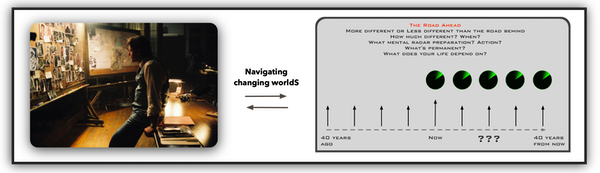
These pages are attention directing tools

for navigating changing worldS — worldS relentlessly

moving toward unimagined futures.


evidence-wall-and-time-line-pict-600

What’s the next effective action on the road ahead


stages-simple-horizons-pict-t


It’s up to you to figure out what to harvest and calendarize
working something out in time (1915, 1940, 1970 … 2040 … the outer limit of your concern)nobody is going to do it for you.

It may be a step forward to actively reject something (rather than just passively ignoring) and then working out a plan for coping with what you’ve rejected.

Your future is between your ears and our future is between our collective ears — it can’t be otherwise.

A site exploration: The memo THEY don't want you to see


Google

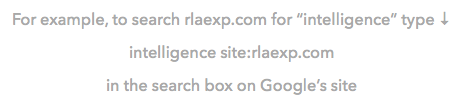
To create a rlaexp.com site search, go to Google’s site ↓

Type the following in their search box ↓

your search text site:rlaexp.com

intelligence-instructions


What needs doing?


contact


#z98 Copyright 1985 through 2025 © All rights reserved | bobembry bobembryusa bobembry.usa | bob embry robert embry | “BrainroadS toward TomorrowS” | “time life navigation” © #TimeLifeNavigation | “life TIME investment system© #LifeTimeInvestmentSystem | “career evolution” © #CareerEvolution | “work-life horizons© | “work-life evolution© | “financial investing© | “life design© #LifeDesign | “organization evolution© | #OrganizationEvolution | “brainroads toward tomorrows” © | #BrainroadsTowardTomorrows | “foundations for future directed decisions© | #FoundationsForFutureDirectedDecisions | #rlaexpdotcom © | rlaexpdotcom ©

#rlaexp.com = rla + exp = real life adventures + exploration or explored

exploration leads to explored

Examples ↑ can be found through web searches, Wikipedia,
Pinterest and the daily news

Knowledge Worker tools on Pinterest


Some ecological and time awareness ↓ → Ken Burns films


tln_components2
Larger view thinking canvas


The Über Mentor

The Drucker Lectures:
Essential Lessons on
Management, Society, and Economy


A Year with Peter Drucker:
52 Weeks of Coaching
for Leadership Effectiveness


tln-radar-annotated2-pict-trans-600
Larger view thinking canvas


#mlp ↓ #z99

My launching pad

(fully responsible officer,
knowledge-worker, professional contributor
and executive)

Discontinued Operations

Worldview